
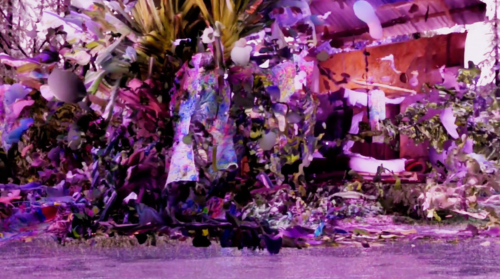
Difracted Exhibit follows a painting as it moves through multiple states of existence. Made in Chiang Mai during the Art Residency Thailand, it is then 3D-scanned across various sites in Thailand — among the plants of Mae Rim, in a wooden house on pillars, around spirit houses and sacred trees in Old Town and Sang Ga U on in Koh Lanta.
Imported into Unreal Engine and rendered through Cine Tracer, these scans fragment the painted surface, redistribute pigment across virtual volumes, make it glitch, scatter, and inhabit spaces that belong neither to the real nor to representation.
The soundtrack comes from Thaahm, a performance given at Thapae East by the Noon Arts Collective. All the sounds played during that performance had been recorded beforehand in the caves of the Satun UNESCO Global Geopark — Tham Le Stegadon, Tham Phu Pha Phet, Tham Urai Thong — and with the indigenous Orang Asli communities.
These underground spaces, this darkness, these non-Western forms of knowledge have run through and shaped the entire work. The sound does not illustrate the images — it is their buried memory, a frequency rising from below.
Paint becomes data. Data becomes presence. Presence becomes noise.
The work settles in none of these states: it keeps moving.
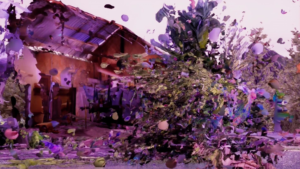
Difracted Exhibit begins with a simple question: what happens to a painting when you no longer document it, but scan it?
A 3D scan does not capture an image of the work — it samples its surface, extracts data from it, separates it from its support. This is not a neutral gesture. It introduces loss, distortion, redistribution. The pigment ends up projected onto geometries that were never its own: roots, walls, offerings.
The scan sites were chosen for their weight — spirit houses, inhabited trees, fig trees associated with invisible presences. These places already operate as a kind of interface: they make visible what cannot be seen directly. In this sense, they are not so far from a polygon mesh or a rendering pipeline. Both systems attempt to give form to something that resists direct representation.
The sound follows the same logic of displacement. Recorded in the caves of the Satun UNESCO Global Geopark — Tham Le Stegadon, Tham Phu Pha Phet, Tham Urai Thong — and with the Orang Asli communities during the Noon Arts Collective’s exchange visit, it was then performed live at Thapae East before being recorded at Woranon Music Studio (Chiang Mai, May 2025, released October 2025). It passes through multiple bodies, places, and states — just as the painting does. It is not a sound illustration: it is an underground memory rising to the surface.
The game engine is not used to simulate reality, but to reveal what the scan produces under pressure: glitch, overlapping layers, aberrant volumes. These artefacts are not corrected — they are the work itself.
Difracted Exhibit does not seek to reconcile animism and technology. It places them in the same space, and watches what happens when two systems share the same surface.
Comments are closed.